
Its not the AI, its what you do with it that counts.

I spent a couple of days at the AWS Summit in Washington, DC, this week. It was big, well attended, informative, and, well, underwhelming.
Of course, as you’d imagine, every talk pretty much had some LLM angle to it, how we did this, how we did that. Some were interesting, others not, but all had the same vibe. Then I spent a bunch of time crawling through the vendor booths; they were a mixed bag. I appreciated the vendors who hadn’t skewed everything they’d traditionally done to try to wrap it in an AI framework. So many of the vendors had “We’ll help you do AI” or “Or we’ll help you do X with AI” on their stands that it got a bit stale.
There were some amazing bits of kit there, don’t get me wrong, AWS Outpost racks, some really superb miltech stuff from Anduril, their Voyager kit, and their large containerised data centres were really cool. But so many of the incumbent software providers were just shilling the same stuff with an AI tag. And that is sad. In the rush to market, innovation seems to have decreased mostly, I believe, due to FOMO. As I’ve said a bunch of times recently, it’s not the vendors with AI enablement that will win, it’s the ones that do novel things that will work their way through the noise and turn out victorious in the end.
As we see with a lot of the engineering software at the moment, it’s not the model that is becoming critical; it’s what you provide alongside the model. We’re going through so many iterations so fast that keeping up and keeping your engineers up to speed is always a hard ask, but if you look at how swiftly things change and how quickly users go from using Claude Code to Codex to Cursor to Kiro. Things don’t stand still, and walking around the AWS booths where companies were offering not much more than they were before, with an LLM hooked on the side to speed up a small aspect of what they did, just wasn’t particularly impressive.
That being said, there were, of course, a number of data providers, companies focused on what underlies the LLMs, because at the end of the day, when working with internal data, the LLM’s responses or what it does with that data are only as good as the data you put into the system.
Some of the more interesting conversations I had were also with companies off to one side, trying to do interesting things. How does Snyk work to detect some of the newer threats we’re seeing? How Chainguard is working to secure the supply chain as increasingly frequent attacks target the open-source ecosystem, CI pipelines, and other easy attack vectors. Because at the end of the day, if you can gain access to multiple businesses as an attacker via a poisoned dependency, that’s an easy in, right? And with LLMs creating code at such speed, we now know the bottleneck isn’t the coding; it’s the review, sign-off, and deployment, which means less attention now gets paid to the software in a mad rush to be the next “Agentic AI-enabled company” on the market.

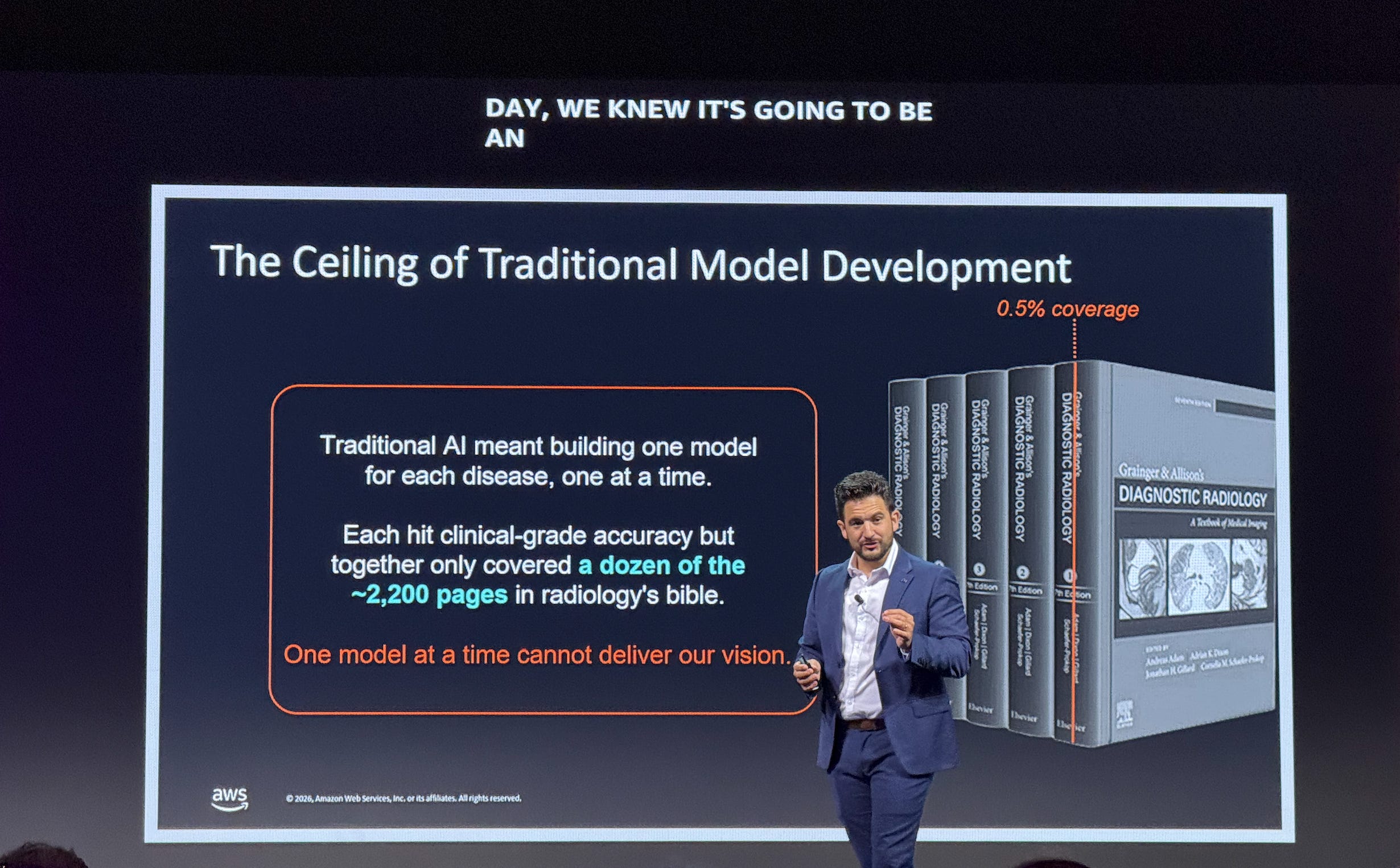
I did, though, mention the talks at the top of this blog. The talk by Aidoc and how they trained their own model was super interesting. The chat by Nick from First Street about how they modelled climate risk alongside business locations accurately was also very interesting, although it sadly glossed over some of the more nerdy aspects of it in the interest of discussing how the AWS AI Office helped them as part of their team, great for the business folks, less interesting for me. Also, in the age of modern warfare, how DARPA and various universities were deploying Edge computing to help with their drone and autonomous robotics programs is super interesting and more about the facts of the program, how they achieved some of it and the wins from it.
All in all, it was a mixed bag. I didn’t go down there needing to learn a bunch of the technical stuff, but I did expect to learn more about what AWS was offering, and I felt like some of that had been lost in the noise. They did a good job of showcasing some of their more interesting use cases, but as I said, they could have got just a bit more technical because you’d believe some of the stuff achieved was magic, but it’s not, as ever, it’s the data.